Don't miss our new customer offer - up to 8% OFF! ( Code: kineo8off )

Adventure Motorcycle Wheels: How to Choose the Right Wheelset

Here’s the thing about adventure motorcycles. You can upgrade the suspension. You can add crash bars. You can bolt on every accessory in the catalog. But wheels? Wheels change everything.
I’m not exaggerating. Your wheelset affects how your bike handles on gravel, how it feels in sand, how it absorbs that pothole you didn’t see coming. It affects your safety when you’re 200 miles from the nearest shop. It determines whether you can actually run the tires you want.
And yeah, wheels are expensive. So most riders just… don’t think about them. They ride whatever came from the factory and figure that’s good enough.
Sometimes it is. Often it isn’t.
This guide breaks down what actually matters when choosing adventure motorcycle wheels. What the differences are between wheel types. What to look for. What to avoid. I’ll get specific because vague advice doesn’t help anyone.
Let’s get into it.
What Are Adventure Motorcycle Wheels?
Adventure motorcycle wheels aren’t just regular motorcycle wheels painted a different color. They’re built different.
These wheels need to handle pavement at highway speeds. But they also need to survive gravel roads, rocky trails, and the occasional mistake. That’s a weird combination of requirements. Sport bike wheels don’t need to worry about rock impacts. Cruiser wheels don’t need to handle washboard dirt roads at 50 mph.
Adventure wheels do both.
Most adventure wheels come in two basic flavors: spoked (wire wheels) or cast alloy. The construction is completely different. The strengths are different. The weaknesses are different too.
Sizes tend to run larger than street bikes. You’ll see 21-inch front wheels on off-road focused machines. 19-inch fronts on more road-biased bikes. Rear wheels typically sit at 17 or 18 inches depending on the model.
Rim widths vary too – and that matters more than people realize. A wider rim changes your tire profile. Changes how the bike handles. Changes what tires you can even run.
The materials matter. Aluminum rims are standard. Spoke quality varies wildly between cheap and premium wheels. Some spokes are stainless steel (good). Some aren’t (not as good). The hub design affects brake compatibility, ABS sensors, speedometer drives.
Point is, there’s a lot going on with these wheels. More than most riders think about.
Why Your Wheelset Choice Matters
Let me put it this way. Your wheels are the only thing connecting your motorcycle to the ground. Everything else – your suspension, your brakes, your tires – works through the wheels.
Bad wheelset choice on an adventure bike means:
- Worse handling on the terrain you actually ride
- More fatigue on long days
- Increased risk of getting stranded
- Less tire selection
- Potential compatibility headaches
Good wheelset choice means the opposite.
Wheels affect weight distribution in ways people underestimate. Lighter wheels mean less unsprung weight. Less unsprung weight means your suspension works better. It responds faster. Your bike feels more nimble.
It’s not subtle either. Riders who swap to quality lightweight wheels notice immediately.
Fuel efficiency? Yeah, wheels affect that too. Lighter rotating mass takes less energy to accelerate. Less energy means less fuel. Over a 500-mile day, it adds up.
Then there’s the durability question. Hit a rock wrong with the wrong wheel and you’re walking. Hit that same rock with wheels built for it and you keep riding.
Wheels can absolutely make or break an adventure trip. I’ve seen it happen.
Types of Adventure Motorcycle Wheels
Adventure motorcycle wheels basically come in two main types. Spoked and cast. There’s some hybrid stuff emerging too, but those are the main categories.
Each has legitimate strengths. Each has real weaknesses. The right choice depends on how you actually ride – not how you imagine riding.
Spoked Wheels
Spoked wheels. Wire wheels. Whatever you want to call them. They’ve been around forever because they work.
The construction is pretty simple in concept. A hub in the center. A rim on the outside. Metal spokes connecting them under tension. That tension is what gives the wheel its strength.
Here’s why adventure riders love them: flex.
Spoked wheels have some give to them. When you hit a rock or a root or a pothole, the wheel can absorb some of that impact. The spokes flex slightly. The energy dissipates across the wheel instead of concentrating in one spot.
That matters off-road. A lot.
You can bend a spoke and keep riding. You can replace individual spokes in the field if you have to. Try doing that with a cracked cast wheel in the middle of nowhere.
Traditional spoked wheels require tube-type tires. The spoke nipples poke through the rim, so you can’t hold air without a tube. That’s been the main drawback for years.
But modern spoked wheels – the good ones anyway – have solved this. Kineo and others now make tubeless spoked wheels with sealed nipples. You get spoke flexibility with tubeless convenience.
Maintenance is higher than cast wheels though. Spokes need checking. They loosen over time, especially after hard off-road rides. A wheel that’s out of true handles weird and wears tires unevenly.
Weight varies a lot. Cheap spoked wheels can be heavy. Quality ones are often lighter than cast alternatives.
For serious off-road adventure riding – real trails, real rocks, real consequences – spoked wheels are usually the answer.
Cast Alloy Wheels
Cast wheels are made differently. Pour molten aluminum into a mold. Let it cool. Machine it to spec. Done.
No spokes to check. No tension to maintain. Just a solid piece of aluminum.
They’re rigid. Very rigid. And on pavement, that’s actually good. Predictable handling. Precise steering input. No flex to worry about.
Tubeless tires work natively. No special sealing required. No tubes to deal with. Get a puncture? Plug it and go.
Maintenance is basically nothing. Inspect for cracks occasionally. Keep them clean if you care about looks. That’s it.
Cost is usually lower than quality spoked wheels too.
The downside? Impacts.
Cast wheels don’t flex. They can’t. Hit something hard enough and you get a crack or a bent rim. And a cracked cast wheel isn’t repairable on the trail. It’s not really repairable at all.
For riders who stay mostly on pavement – and I mean 80% or more – cast wheels make a lot of sense. Less maintenance. Tubeless convenience. Lower cost.
But if you’re doing real off-road? If you’re hitting trails where impacts happen? Cast wheels are a risk.
Hybrid Options
The market keeps evolving. Some manufacturers are working on designs that try to combine spoked flexibility with cast-wheel convenience.
Tubeless spoked wheels are probably the biggest development. Companies like Kineo have basically perfected this. You get the impact absorption of spokes with the tubeless capability of cast wheels.
There are also forged wheels that are stronger than cast but still rigid. Some exotic materials like carbon fiber showing up in premium applications.
The hybrid space is interesting. Worth watching. But for most adventure riders, the choice is still between traditional spoked and cast – or modern tubeless spoked if budget allows.
Key Factors to Consider When Choosing Adventure Motorcycle Wheels
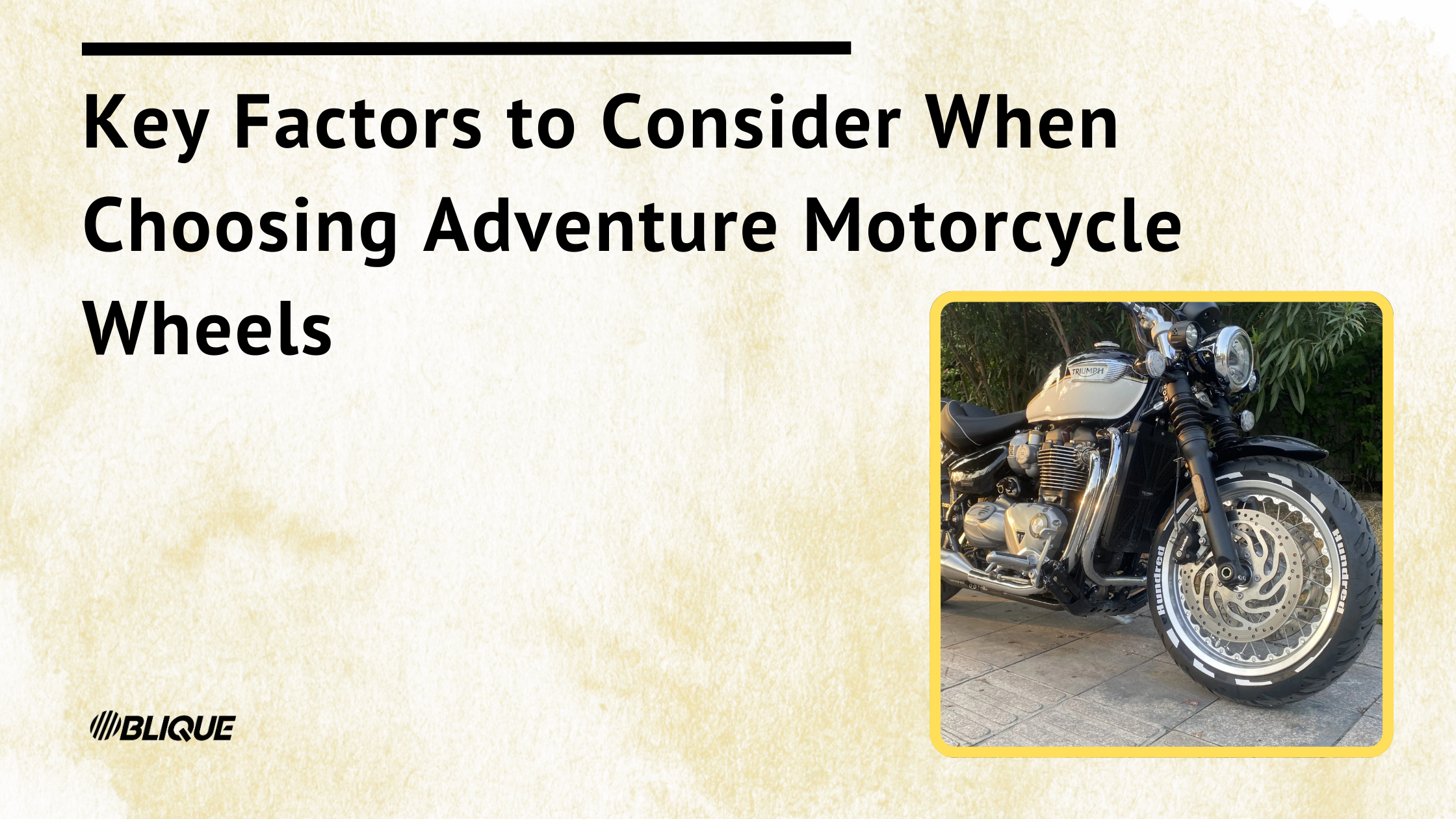
Okay. You understand the basic wheel types. Now let’s talk about what actually matters when choosing.
This isn’t one-size-fits-all. Your right answer depends on your bike, your riding, your priorities.
1. Riding Terrain and Style
Be honest with yourself here. Where do you actually ride? Not where you want to ride. Not where you plan to ride someday. Where you ride now.
Some questions worth answering:
- What percentage is pavement vs. dirt?
- When you’re off-road, what kind? Gravel roads? Fire roads? Technical single track?
- How long are your typical trips?
- Do you commute on this bike?
If you’re 50/50 or more off-road, spoked wheels make sense. The impact resistance matters when you’re actually hitting obstacles.
If you’re 80/20 on-road with occasional gravel, cast wheels are probably fine. You’re not putting them through the abuse that exposes their weakness.
The 60/40 or 70/30 rider is where it gets interesting. Could go either way. Depends on how aggressive that 30-40% off-road portion is.
A gravel road isn’t really off-road. Not in any meaningful sense. Technical trails with rocks and roots? That’s different.
Be honest about this. It saves money and headaches.
2. Wheel Size and Rim Width
This gets into the weeds a bit, but it matters.
Common adventure motorcycle setups:
Off-road focused: 21″ front, 18″ rear. The bigger front wheel rolls over obstacles better. Climbs out of ruts easier. This is your typical dual-sport setup.
Road focused: 19″ front, 17″ rear. More street bike geometry. Better for highway stability and cornering on pavement. Less capable off-road, but most riders don’t notice unless things get technical.
Middle ground: 19″ front, 18″ rear. A lot of adventure bikes come this way. Compromise setup. Does neither thing perfectly but does both things acceptably.
Rim width affects tire selection and profile. A wider rim spreads the tire out more. Changes the shape. Changes the handling characteristics.
Going bigger than stock affects your speedometer accuracy. Changes your gearing effectively. Can require suspension adjustments.
Smaller sometimes works but limits tire options. Most riders stick with OEM sizes unless they have specific reasons to change.
If you deviate from stock sizes, know why you’re doing it. Don’t just change things for the sake of change.
3. Weight Considerations
Wheel weight matters more than most riders realize. And it’s not just total weight – it’s where the weight is.
Unsprung weight is the stuff that moves with your suspension. Wheels, tires, brakes (partially). Lower unsprung weight means your suspension can react faster. The wheel follows terrain better. Bumps feel smaller.
It’s not placebo either. Engineers obsess over unsprung weight for good reason.
Spoked wheels and cast wheels overlap in weight. Cheap spoked wheels can be heavy. Premium cast wheels can be light. But high-end spoked wheels tend to be lighter than comparable cast options.
The Kineo tubeless spoked wheels, for example, are notably lighter than most OEM cast wheels. You feel that difference on a long ride.
Lighter wheels also mean faster acceleration and shorter stopping distances. Less rotational mass to speed up or slow down.
For adventure touring – long days, varied terrain – reduced wheel weight means reduced fatigue. Your suspension does more work so your body does less.
Carbon fiber wheels exist. They’re stupid light. They’re also stupid expensive. For most adventure riders, aluminum with quality spokes is the sweet spot.
4. Durability and Strength
Adventure riding puts wheels through things street riding never does.
Rocks. Roots. Potholes you didn’t see. The occasional drop. These all stress wheels in ways that matter.
Spoked wheels handle impacts by distributing force across the spoke pattern. Flex absorbs energy. Individual spokes can be damaged without killing the whole wheel.
Cast wheels handle impacts by… taking it. If the impact is within their limits, fine. If it exceeds their limits, you have a problem.
Spoke count matters for strength. More spokes generally means more strength and better load distribution. Spoke thickness and material matter too. Stainless steel spokes resist corrosion better than chrome-plated options.
Rim thickness affects dent resistance. Thinner rims are lighter but dent easier. There’s a balance.
For aggressive off-road riding, durability should rank high in your priorities. A lightweight wheel that breaks isn’t actually saving you anything.
For primarily on-road use, you can optimize more for weight and less for impact resistance.
5. Tubeless vs. Tube-Type Compatibility
This is a bigger deal than it sounds.
Tube-type wheels require inner tubes. Get a puncture and the tube goes flat. Repair means removing the tire, patching or replacing the tube, reinstalling everything. Not quick. Not easy in the field.
Tubeless wheels hold air in the tire itself. Get a puncture and you can often plug it from outside the tire. Takes a few minutes. Doesn’t even require removing the wheel in most cases.
For adventure riding, tubeless has obvious advantages. Faster puncture repair. Ability to run tire sealant for automatic small puncture sealing. Less hassle overall.
Traditional spoked wheels were tube-only. That’s changing. Modern tubeless spoked wheels seal at the nipples, letting you run tubeless tires.
Kineo pioneered a lot of this technology. Their tubeless spoked wheels have been proven over years of hard use.
If you go tubeless spoked, you get both advantages. Spoke flexibility for impacts. Tubeless convenience for punctures.
One note: even with tubeless capability, carrying an emergency tube isn’t a bad idea for remote adventure riding. Belt and suspenders approach. If your tire sidewall gets damaged, a plug won’t help but a tube might get you home.
6. Maintenance Requirements
Different wheels need different care. Know what you’re signing up for.
Spoked wheels need regular spoke tension checks. New wheels should be checked after the first 100 miles, then periodically after. Spokes loosen. It happens. Catching it early prevents bigger problems.
Wheels can go out of true (not perfectly round) over time or after impacts. Truing a wheel requires skill and equipment. Some riders learn to do it themselves. Others take it to a shop.
Spoke nipples can corrode if they’re not stainless or quality brass. Corroded nipples are hard to adjust and can seize.
Cast wheels need almost nothing. Inspect for cracks occasionally. Especially after impacts. A cracked wheel can fail catastrophically if you keep riding on it.
Keep bearings clean and greased. That applies to any wheel.
For adventure touring in remote areas, spoked wheels offer better field serviceability. You can adjust spokes with basic tools. Can’t do anything about a damaged cast wheel.
For local riding with easy shop access, cast wheel maintenance is simpler.
7. Budget and Value
Wheels are expensive. Good wheels are really expensive. But they’re also a long-term investment.
Cast wheels generally cost less. Mid-range cast wheels might run $400-800 for a set. Quality stuff is higher.
Spoked wheels vary wildly. Budget spoked wheels can be cheap. Premium tubeless spoked wheels like Kineo run into four figures per wheel.
The price difference reflects manufacturing complexity, materials, and engineering.
Here’s how I think about it: a quality wheelset that lasts 50,000+ miles costs you pennies per mile. A cheap wheelset that needs replacing at 20,000 miles or leaves you stranded costs more in the long run.
Factor in tire compatibility too. Some wheels work with more tire options than others. Being able to run whatever tire suits your needs has value.
And consider downtime costs. If a wheel failure ends a trip early or leaves you stranded, what’s that worth?
I’m not saying everyone needs the most expensive wheels. I’m saying buy quality appropriate to your use. Spending $2000 on wheels for a $5000 bike that stays on pavement might not make sense. Spending $2000 on wheels for serious backcountry touring makes a lot of sense.
8. Motorcycle Compatibility
This is where things get technical. And it matters a lot.
Wheels aren’t universal. They’re designed for specific motorcycles or at least specific hub standards.
Things that need to match:
- Hub design – must fit your axle and spacers
- Brake rotor mounting – bolt pattern and diameter
- ABS sensor compatibility – if your bike has ABS, the wheel needs the sensor ring
- Speedometer drive – some bikes take the speed signal from the front wheel
- Axle size – diameter and length
- Offset – how the wheel centers in the swingarm/forks
Getting any of these wrong creates problems. Best case, the wheel won’t fit. Worst case, it fits but doesn’t work correctly – and you discover this at the worst possible time.
Reputable wheel manufacturers list compatibility clearly. Kineo, for example, makes application-specific wheels for most major adventure motorcycles. They fit right, first time, with proper function.
Cheap generic wheels sometimes claim “universal fit” through adapters or modifications. Approach these carefully. Adapters add weight, potential failure points, and complexity.
Stick with wheels designed for your specific bike whenever possible.
Top Adventure Motorcycle Wheel Brands
A few names come up repeatedly in the adventure motorcycle community. These have earned trust through actual performance.
Kineo Wheels
Kineo makes what many consider the premium option for adventure motorcycle wheels. Italian manufacturing. Beautiful aesthetics. Serious engineering.
Their big thing is tubeless spoked wheels. Aluminum rims with stainless steel spokes, sealed at the nipples for tubeless operation. You get the impact absorption of spokes with tubeless convenience.
The strength-to-weight ratio is excellent. These are lighter than most OEM cast wheels while being stronger for off-road use.
They’re not cheap. Nobody pretends they are. But the riders who run Kineo wheels tend to be extremely loyal to them. They work.
Build quality is obviously high. Fit and finish is excellent. Wide compatibility across adventure motorcycle brands – BMW, KTM, Honda, Yamaha, Suzuki, etc.
For serious adventure riders who want the best, Kineo is the standard a lot of people measure against. Check out the options at kineoshop.com if you want to see what’s available for your bike.
Excel Rims
Excel has been in the game a long time. Their rims show up on OEM bikes and aftermarket builds alike.
Known for durability. Popular in the off-road and racing communities. If you’re having a custom wheelset built, Excel rims are a solid choice.
More of a component supplier than a complete wheel manufacturer. You’ll often see Excel rims laced to various hubs.
Talon Engineering
Talon makes hubs and complete wheelsets. Big presence in racing, especially motocross and enduro.
Popular for custom builds when you want to spec exactly what you want. Quality is good.
More common in the dirt bike world than big adventure bikes, but they do offer options for some ADV applications.
OEM (Original Equipment Manufacturer) Wheels
Don’t automatically assume you need to replace your stock wheels.
Many OEM wheels are genuinely good. Manufacturers have gotten better at spec’ing appropriate wheels for adventure bikes. Some premium adventure motorcycles come with quality spoked wheels from the factory.
Upgrading makes sense when:
- Your riding exceeds what the stock wheels were designed for
- You want tubeless capability on a bike that came with tube-type spoked wheels
- Weight savings matter to you
- Stock wheels are damaged
Upgrading might not make sense when:
- Stock wheels match your actual riding style
- Budget is tight
- You’re not putting serious miles on
Be realistic about whether you need an upgrade or just want one. Nothing wrong with wanting one, but know the difference.
Can I convert my cast wheels to spoked wheels?
Usually, yes. But it’s a full wheelset replacement, not a conversion in the true sense.
You’re buying complete new wheels – rim, spokes, hub, everything. The new hubs need to be compatible with your bike’s axles, brakes, and sensors.
It’s not cheap. Figure on $1500-3000+ for quality spoked wheels depending on your bike and what you choose.
Is it worth it? Depends entirely on how you ride. If you’re doing serious off-road and your bike came with cast wheels, it might be the best upgrade you can make. If you’re mostly on-road, probably not.
Are tubeless spoked wheels reliable off-road?
Yes. Modern ones are, anyway.
The old worry was that sealed spoke nipples would fail and leak air. That was a legitimate concern with early designs.
Current tubeless spoked wheels from reputable manufacturers (Kineo being the obvious example) have proven reliable in hard use. The sealing technology has matured.
That said, I still recommend carrying an emergency tube for remote adventure riding. Sidewall damage can defeat any tubeless setup, and a tube is cheap insurance.
How often should I check spoke tension?
New wheels: check after the first 100 miles. Spokes bed in and can loosen initially.
After that: every 1000-2000 miles for normal riding. Sooner if you’ve done aggressive off-road work.
How to check: tap each spoke with a wrench or spoke tool. They should all ring at roughly similar pitches. A dull thud means a loose spoke.
Proper checking with a spoke tension meter is more accurate. Worth learning if you plan to maintain your own wheels.
What’s the lifespan of adventure motorcycle wheels?
Depends on the wheels and how you treat them.
Quality wheels, properly maintained, can go 50,000+ miles. Sometimes much more.
Factors that shorten lifespan:
- Neglected spoke tension (spokes fatigue faster when loose)
- Repeated heavy impacts
- Corrosion from salt or moisture
- Running damaged wheels instead of repairing them
A cracked rim is done. A rim with damaged spoke holes is done. Bent rims can sometimes be straightened but it’s not always worth it.
For the investment, wheels typically last longer than most other components on your motorcycle.
Do lighter wheels really make a noticeable difference?
Yes. Genuinely yes.
I was skeptical about this until I experienced it. The difference is real and noticeable.
Lighter wheels, especially the reduction in unsprung weight, make your suspension work noticeably better. The bike feels more agile. Direction changes feel easier. Bumps feel smaller.
On long rides, you feel less beat up at the end of the day. That’s the cumulative effect of your suspension doing more work.
Acceleration and braking are quicker too, though most riders notice the handling and comfort improvements more.
Is it worth the cost of premium lightweight wheels? That depends on your budget and priorities. But the improvement isn’t imaginary.
Can I use different front and rear wheel types?
Technically, yes. Nothing stops you from running a spoked front and cast rear, or vice versa.
Does it make sense? Rarely.
The usual argument is: impacts happen more on the front wheel, so put spokes there and save money with cast on the rear.
The counterargument: if you’re doing terrain that needs spoked front wheels, you’re probably doing terrain that will eventually catch the rear wheel too.
Mixed setups also look weird, if that matters to you.
Most riders either run spoked front and rear or cast front and rear. Pick the type that matches your riding and run it on both ends.