Don't miss our new customer offer - up to 8% OFF! ( Code: kineo8off )

TÜV Certified Tubeless Wheels: What It Means and Why It Matters

For decades, if you wanted spoked wheels on your motorcycle, you accepted inner tubes. No way around it. The spoke nipples poked through the rim. Air escaped. Tubes were mandatory.
That’s not true anymore. But here’s the thing most people don’t realize. Building a tubeless spoked wheel is only half the challenge. Getting that wheel certified to meet the strictest safety standards in the world? That’s where things get serious.
TÜV certification isn’t something manufacturers pursue for fun. It’s expensive. It’s time-consuming. It requires actual engineering excellence, not just marketing claims. When a tubeless spoked wheel carries TÜV certification, it means the design, the manufacturing process, and the finished product all passed independent verification by one of the toughest testing bodies on the planet.
This matters if you care about what’s underneath you at highway speeds. Or on gravel roads far from help.
The old “spoked wheels need tubes” limitation is dead. But not every tubeless spoked wheel you see advertised has actually proven itself worthy of that claim. TÜV certification separates the real thing from wishful thinking.
What Are Tubeless Spoked Wheels?
Tubeless spoked wheels hold air without an inner tube while keeping traditional wire spokes connecting the hub to the rim. Sounds simple when you say it. Wasn’t simple to engineer.
Here’s the key distinction. Cast wheels have always been tubeless. One solid piece of metal. No holes. Air stays in.
Spoked wheels presented a problem. Spoke nipples traditionally penetrate the rim bed. Each nipple creates a potential air leak. Multiply that by 36 or 40 spokes and you’ve got a rim that can’t hold pressure without a tube inside.
Modern engineering solved the sealing problem while preserving what makes spoked wheels valuable in the first place. The flexibility. The ability to true a bent rim. The option to replace individual spokes without scrapping the whole wheel.
Tubeless spoked wheels give riders both things at once. Wire spoke aesthetics and function with tubeless convenience and safety.
How Tubeless Spoked Wheels Work
Several engineering approaches make tubeless spoked wheels possible. Different manufacturers use different methods.
Sealed rim construction keeps spoke nipples out of the air chamber entirely. Some designs weld nipples directly to the outer rim surface. Others use special caps or gaskets over each nipple.
Two-layer rim designs separate functions. The inner layer creates an airtight chamber. The outer layer holds the spoke nipples. Air never contacts the nipple penetration points.
Precision welding seals each nipple individually in some systems. Every connection point gets verified. No shortcuts.
Once the rim is properly sealed, the tire mounts like any tubeless setup. Bead locks against rim. Sealed valve stem. Standard tubeless procedure.
The slow-leak advantage shows up during punctures. Pick up a nail with a tubed wheel and the tube deflates fast. Sometimes instantly. With tubeless, the object often stays in the tire. Air leaks slowly around it. You might get 50 miles or more to reach a repair shop instead of stopping immediately on the shoulder.
What is TÜV Certification?
TÜV is a European auditing and certification body. German origin. They ensure products manufactured for sale in Germany, Switzerland, and Austria meet international ECE Regulations, EC (European Community) directives, and German Motor Traffic Agency (KBA) road traffic legislation.
That’s a lot of bureaucratic words. Here’s what it means practically.
TÜV certification is considered one of the most highly-respected certifications for automotive products in the world. These aren’t people who rubber-stamp applications and collect fees. They actually test things. They audit facilities. They verify claims.
Getting TÜV certified is difficult by design. That’s the point.
TÜV certification matters beyond Europe too. Riders in the US, Australia, Asia—anywhere—can use TÜV certification as a quality benchmark. If a wheel passed TÜV testing, it met standards that many regional certifications don’t come close to matching.
The Three Pillars of TÜV Wheel Certification
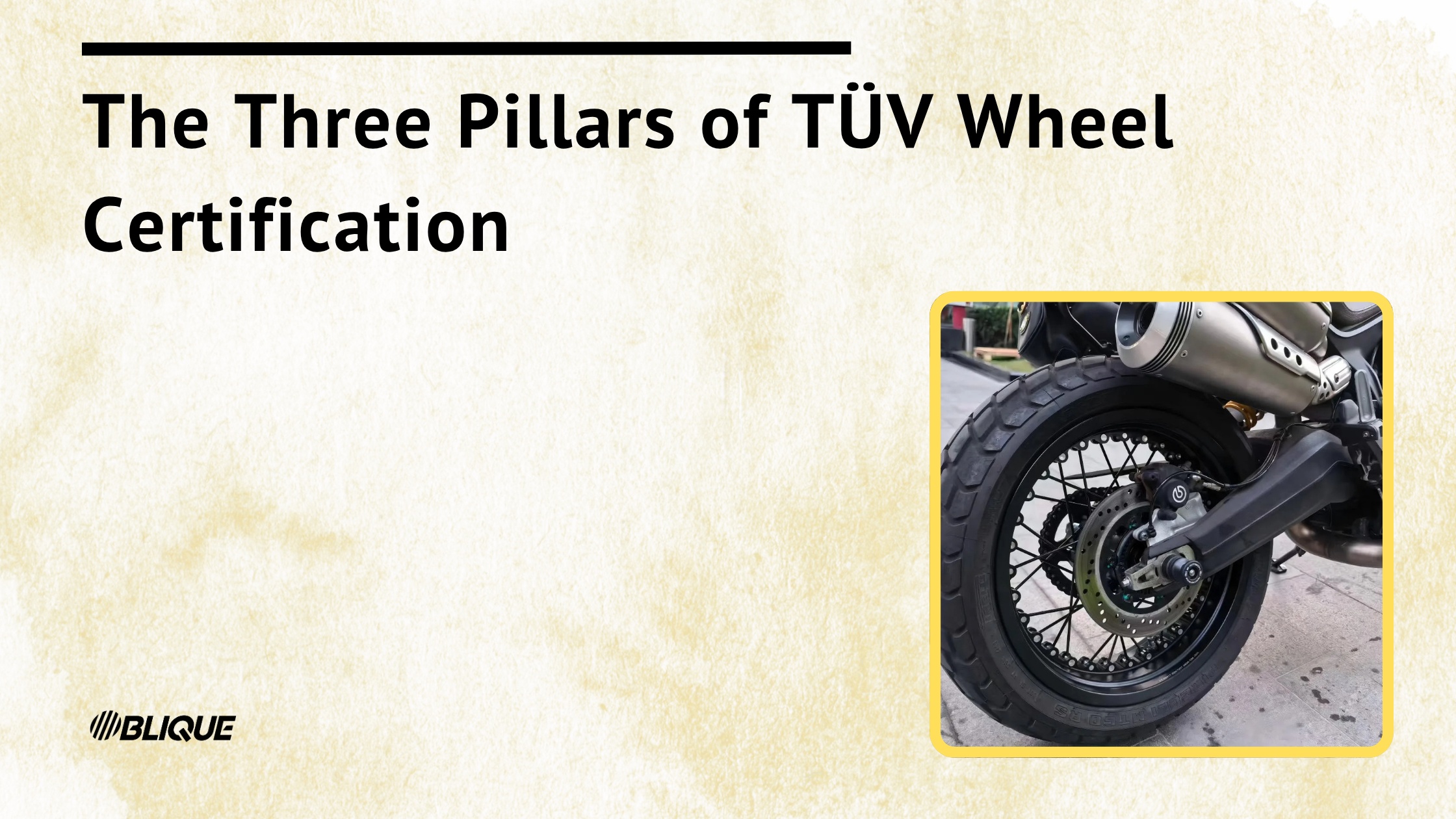
TÜV certification for wheels isn’t a single test or a single document. It requires meeting three distinct criteria. Each one gets verified independently. Miss any of the three and you don’t get certified.
Obtaining all three is time-consuming. It’s expensive. It demonstrates manufacturer commitment to quality and safety that goes far beyond what’s legally required in most markets.
1. Manufacturer Certification (Quality Management System)
This first pillar certifies the wheel manufacturer’s quality management system. Not just the product. The entire operation.
Important detail: only actual manufacturers can obtain this certification. Not resellers. Not brands that outsource production and slap their logo on someone else’s wheels. The facility that actually makes the wheels.
The audit process works like this. TÜV authorities from Europe visit the manufacturing facility. They examine processes, quality controls, documentation, everything. Similar to an ISO 9001 audit. This happens every three years minimum.
Why does this matter? It prevents “ringers.” A company can’t send their absolute best hand-built wheel to testing and then mass-produce junk for customers. The facility audit ensures all wheels manufactured meet the same standards consistently.
This pillar separates genuine manufacturers from companies making claims they can’t back up.
2. Wheel Testing Certificates (Product Performance)
The second pillar certifies that wheels conform to geometric standards and have passed structural fatigue and impact requirements for specific vehicle and load rating requirements.
Key word: specific. Testing isn’t generic. You can’t test one wheel style and claim certification for your entire catalog.
Each style gets tested with proper widths, offsets, and load ratings for appropriate vehicle targets. A 17-inch wheel certified for a specific motorcycle application required testing for that application. Different width, different offset, different load rating—different test required.
Test types include cornering fatigue, radial fatigue, and impact testing. All performed at specified load ratings, often higher than actual design loads to build in safety margins.
This pillar is time-consuming and expensive. Manufacturers offering multiple fitments across many motorcycle models face substantial testing investment. Each configuration requires verification.
Certification documentation specifies exactly what was tested: specific width, offset, PCD, and load rating. If your wheel doesn’t match those specifications, the certificate doesn’t apply.
3. Vehicle Owner Certification (Legal Compliance)
The third pillar is the certificate vehicle owners receive from TÜV authorities showing wheels are TÜV certified for their specific vehicle.
This allows legal vehicle registration and passing annual inspections in Germany, Switzerland, and Austria. Similar concept to MOT certification in the UK. The government wants proof your modifications meet safety standards.
Important clarification: wheel manufacturers don’t supply this document directly. Owners obtain it through TÜV authorities based on the manufacturer’s testing certificates and facility certification.
This represents the final step making certified wheels road-legal in Europe’s most stringent markets. The system works because all three pillars connect. Facility certification ensures quality. Product testing ensures performance. Owner documentation ensures accountability.
Why TÜV Certification Matters for Tubeless Spoked Wheels
Tubeless spoked wheels represent advanced engineering. Complex manufacturing. Multiple potential failure points if done wrong.
TÜV certification proves that engineering meets rigorous safety standards. Independent verification. Not manufacturer marketing.
Anyone can claim their wheels are “tubeless.” Anyone can claim “highest quality” or “tested to standards.” TÜV provides third-party verification that means something.
The benefits compound. Peace of mind knowing the design passed real testing. Proven durability under conditions that exceed normal riding stress. Compliance with the strictest automotive safety regulations on the planet. Quality assurance extending from manufacturing facility to the final product in your hands.
Safety and Performance Standards
TÜV certification addresses specific safety aspects that matter when your wheel hits a pothole at 80 mph.
Structural integrity under load. Your wheel needs to handle your bike’s weight plus rider plus luggage plus cornering forces plus braking forces. Combined. Repeatedly. For tens of thousands of miles.
Fatigue resistance over time. Metal fatigues. Welds can crack. Spokes loosen. TÜV testing accelerates this process to verify wheels survive long-term use.
Impact resistance. Potholes. Rocks. Debris. Things hit wheels constantly. Certified wheels proved they handle impacts without catastrophic failure.
Geometric precision matters for tubeless function specifically. Tire bead seating requires exact rim profiles. The seal between tire and rim depends on precise manufacturing. TÜV verification includes geometric standards.
These standards directly impact rider safety. Especially for adventure and off-road riding where wheels face extreme stress regularly. Knowing your wheels passed independent testing under severe conditions provides real confidence.
Global Quality Benchmark
TÜV certification is legally required in Germany, Switzerland, and Austria. That’s the technical reality.
But the certification serves as a global quality indicator regardless of your location. Manufacturers who achieve TÜV certification demonstrate commitment to the highest standards. Not just what their local market requires. The global top tier.
Riders in the United States, Australia, Japan—anywhere—can benefit from this certification even when it’s not legally required. The testing happened. The standards were met. The verification exists.
Other certifications exist for various markets. JWL in Japan. DOT markings in the US. Most don’t approach TÜV’s comprehensiveness. The facility audits, the vehicle-specific testing, the documentation requirements—TÜV’s system is more rigorous than what most regulations demand.
Key Benefits of TÜV Certified Tubeless Wheels
What do riders actually gain? Let’s be specific.
Compared to traditional tubed spoked wheels: convenience, safety during punctures, compatibility with modern tire technology.
Compared to cast wheels: flexibility, repairability, impact absorption, aesthetics.
TÜV certification adds: verified quality, proven testing, regulatory compliance, peace of mind.
Enhanced Safety Features
The slow-leak advantage during punctures deserves emphasis. It’s not a small thing.
Puncture a tubed wheel. The tube tears or deforms around the object. Air rushes out. You might have seconds to react before the tire is flat.
Puncture a tubeless wheel. The object—nail, screw, whatever—often stays embedded in the tire. Air leaks slowly around the object. Depending on puncture size and speed, you might ride 50 miles or more to reach a repair shop.
That’s the difference between a roadside emergency and an inconvenience you handle at the next town.
TÜV certification adds verified structural integrity. The wheels proved they handle the loads they’re rated for. Impact resistance was tested. Fatigue resistance was tested. Not claimed. Tested.
Modern tubeless wheels also support tire pressure monitoring systems. Useful technology that tubed wheels often can’t accommodate easily.
Performance Advantages
Spoked wheels flex. That flexibility absorbs impacts that would crack cast wheels. Hit a rock hard enough to dent a cast rim and you might be done riding. Same impact on a quality spoked wheel? Might bend a spoke. Replace the spoke. Continue riding.
Spoked wheels can be trued. Bent rim from a bad hit? A skilled mechanic (or a prepared rider) can true the wheel trailside if necessary. Try that with a bent cast wheel.
Individual spoke replacement happens without wheel disassembly or tire removal in most cases. Damaged spoke gets replaced. Wheel gets trued. Back in business.
Weight savings versus tubed setup matter too. No inner tube means less rotating mass. Better heat dissipation during hard riding. Improved handling characteristics at the margins.
For off-road, adventure riding, and challenging terrain, these advantages compound. The combination of flexibility, repairability, and tubeless convenience makes certified spoked wheels ideal for situations where cast wheels show their weaknesses.
Maintenance and Reliability
Comparing maintenance requirements favors tubeless.
No tube pinching during tire changes. Anyone who’s changed tubed tires knows the frustration of pinching a new tube and having to start over. Tubeless eliminates this entirely.
No tube-rim rubbing wear. Tubes move inside tires. They rub against rim tape. They wear. Tubeless setups don’t have this failure mode.
Puncture repairs become simpler. Plug and inflate versus full tube replacement. Modern tubeless repair kits work with tubeless spoked wheels just like they work with cast wheels. Roadside repairs get faster.
Compatibility with tire sealants adds another layer of puncture protection. Some riders pre-treat tubeless tires with sealant. Small punctures seal automatically.
Long-term reliability has improved dramatically as tubeless spoked technology matured. Early versions had seal issues. Modern certified wheels use corrosion-resistant materials, durable anodized finishes, and proven sealing technology that holds up over years of use.
Classic Aesthetics with Modern Technology
This is the “why bother” answer for many riders.
Traditional wire-spoked wheels look right on certain motorcycles. Classic bikes. Retro builds. Adventure machines. Scramblers. The visual matters.
But tubed wheels have real disadvantages. The slow-leak safety benefit alone justified the engineering investment in tubeless technology.
For years, riders chose between looks and performance. Spokes meant tubes meant accepting the limitations. Cast meant tubeless meant accepting the appearance.
TÜV certified tubeless spoked wheels eliminate that choice. Classic appearance. Modern performance. Verified safety.
Customization options exist too. Spoke colors. Rim finishes. Hub options. Certified doesn’t mean standardized. Riders still build wheels that match their vision.
TÜV Certification Verification
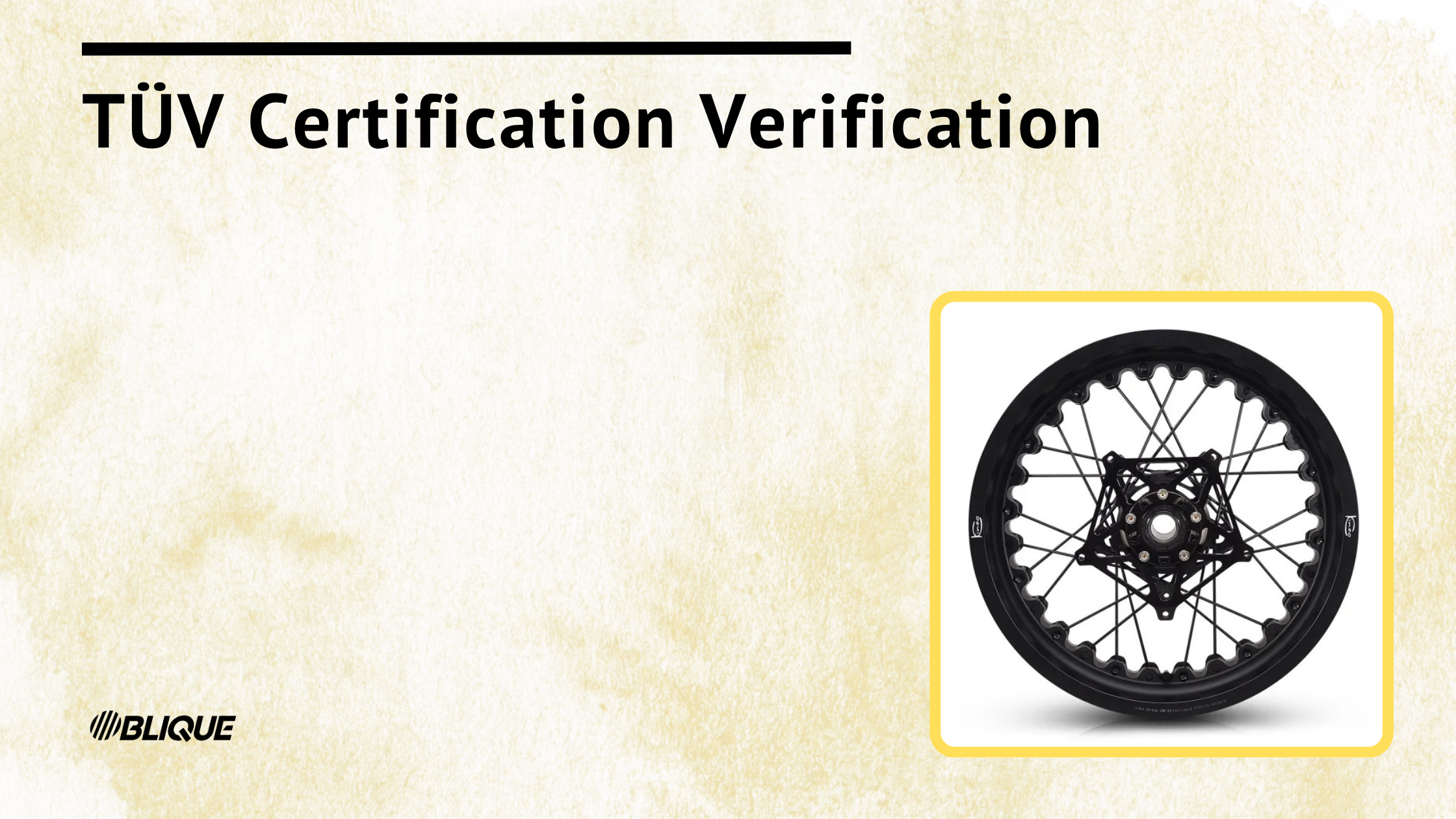
TÜV themselves warn about false claims in the marketplace. Not everyone advertising “TÜV certified” actually earned it.
Knowing how to verify claims protects buyers from expensive mistakes.
How to Verify TÜV Certification is Legitimate
TÜV maintains an online certificate search system specifically to prevent false claims. Legitimate certifications can be verified.
What to look for:
TÜV Registration ID number. Every certified manufacturer has one. Format varies but it’s a specific identifier that can be searched.
Manufacturer certification. Facility audit certificates proving the manufacturing operation passed quality system review.
Wheel testing certificates. Specific to style, width, offset, and load rating. Generic “our wheels are certified” claims without specifics deserve skepticism.
Documentation trail. Legitimate manufacturers can provide paperwork. Vague responses suggest problems.
Warning: some companies hold TÜV certificates for completely unrelated products. Toys. Appliances. Electronics. That certification means nothing for motorcycle wheels. A TÜV certificate for children’s furniture doesn’t qualify anyone to sell certified motorcycle wheels.
Ask for the manufacturer’s TÜV ID number. Check TÜV’s certificate search database. Verify the certification applies to wheels specifically and to the configuration you’re considering.
Questions to Ask Manufacturers
Before purchasing wheels advertised as TÜV certified, ask specific questions:
- Is your manufacturing facility TÜV certified for wheel production?
- What is your TÜV Registration ID number?
- Are these specific wheels—this style, this size, this fitment—tested and certified?
- Can you provide wheel testing certificates for my specific application?
- Which vehicles and load ratings are these wheels certified for?
- How often does your facility undergo TÜV audits?
- When was the most recent audit?
Legitimate manufacturers answer these questions easily. They have documentation. They’re proud of their certification because they earned it.
Hesitation, vague answers, or inability to provide documentation suggests claims that can’t be verified. In that case, the “TÜV certified” marketing might be creative interpretation rather than fact.
This checklist empowers buyers to distinguish genuinely certified products from companies hoping nobody checks.