Don't miss our new customer offer - up to 8% OFF! ( Code: kineo8off )

Custom Motorcycle Wheels: How Custom Wheelsets Are Built

Stock wheels get the job done. But “getting the job done” isn’t why most of us ride.
Custom motorcycle wheels change everything about a bike. The way it looks. The way it handles. The way people stare when you roll up somewhere. I’ve seen guys drop serious money on exhaust systems and paint jobs, then completely ignore their wheels. Makes no sense to me. Wheels are the thing that actually touches the ground. They affect performance more than almost anything else you can bolt on.
Here’s the thing about custom wheels — they’re not just about looking good. Though yeah, they look incredible. You’re getting weight savings, better handling, improved braking response. And you’re getting something nobody else has. Your bike. Your wheels.
The build process isn’t simple. It’s not like ordering a part off Amazon. These things are engineered, machined, balanced, finished. There’s real craftsmanship involved. Some shops have been doing this for decades, and they’ve got it down to a science.
We’re gonna walk through all of it. The types of wheels, the materials, the actual step-by-step process of how a custom wheelset gets built. Whether you’re thinking about ordering a set or just curious how it all works, this covers everything.
What Are Custom Motorcycle Wheels?
Stock wheels are what comes on your bike from the factory. OEM stuff. Designed to work across thousands of identical motorcycles. They’re fine. They’re engineered to meet certain standards, handle certain loads, fit certain tires.
Custom motorcycle wheels are different. They’re built for your bike. Sometimes for your specific riding style.
The customization can happen at a bunch of different levels. Material choice is a big one — you’ve got cast aluminum, forged aluminum, billet, carbon fiber. Each has tradeoffs. Then there’s sizing. Width, diameter. You can run a fatter rear tire or a bigger front wheel depending on what you’re after.
Finishes get wild. Chrome, powder coating in basically any color, anodizing, brushed metal, matte black. I’ve seen some really tasteful stuff and some really questionable stuff. Personal preference, I guess.
Spoke patterns matter too if you’re going that route. Different lacing patterns give different looks and different strength characteristics. Hub designs vary. Some are super aggressive, some are clean and minimal.
There’s a difference between semi-custom and fully custom builds. Semi-custom usually means you’re picking options from an existing catalog — picking a wheel style, then choosing size and finish for your specific bike. Fully custom means someone’s designing and building wheels from scratch, just for you. Obviously that costs more. A lot more.
Different bikes need different things. Cruiser guys want a certain look. Sport bike riders care more about weight. Touring riders need durability above all else. Good custom wheel builders understand this and work with you on it.
Why Choose Custom Motorcycle Wheels Over Stock?
There’s a handful of solid reasons people go custom. Some care about performance. Some care about looks. Most care about both.
Here’s what you’re actually getting:
- Real performance improvements — not just on paper
- Exactly the look you want
- Better build quality than most stock wheels
- Something unique to your bike
- Proper fitment for how you actually ride
Let me break these down.
1. Performance Benefits
This is the one that skeptics don’t always believe until they experience it.
Wheels are unsprung weight. That’s the weight not supported by your suspension. Reduce it, and everything changes. Your suspension works better because it’s not fighting as much mass. Acceleration improves because the wheel has less rotational inertia — it spins up faster. Braking gets sharper for the same reason.
Handling feels different too. More responsive. The bike changes direction quicker. It’s not dramatic like swapping engines, but it’s noticeable. Especially if you’re going from heavy cast stock wheels to quality forged customs.
There’s also power transfer. A stiffer wheel with better construction puts more of your engine’s output to the pavement instead of flexing.
I’m not making this up. The physics are straightforward. Lighter rotating mass = better everything.
2. Aesthetic Customization
Okay, let’s be honest. A lot of people start here.
The options are kind of endless. Finishes include:
- Chrome (classic, but high maintenance)
- Powder coating in hundreds of colors
- Anodizing for aluminum wheels
- Matte, satin, or high gloss
- Ceramic coatings
- Bare brushed metal with clear coat
You can color match to your tank, your frame, whatever. Contrasting colors work too. Black wheels on everything is popular for a reason — it looks clean on almost any bike.
Spoke patterns give totally different vibes. Five-spoke, six-spoke, ten-spoke. Y-spokes, split spokes. Some are aggressive. Some are classic. Traditional wire spoked wheels have their own whole thing going on.
Custom logos, engravings, unique hub designs. I’ve seen some wild one-off stuff that probably cost as much as the bike it was going on. Not my style, but I respect the commitment.
Point is — your wheels are one of the most visible parts of your motorcycle. Custom wheels complete the look in a way nothing else can.
3. Durability and Quality
Here’s something people don’t always think about.
Stock wheels are built to a price point. The manufacturer has to keep costs down across thousands of units. That means compromises somewhere.
Custom wheels from reputable builders? Different standards. Better materials. Better manufacturing processes. More attention to detail because they’re not cranking out 50,000 identical units a year.
The finishes tend to last longer too. Good powder coating or anodizing resists corrosion better than a lot of factory finishes. The wheel itself is often more resistant to damage from potholes, debris, whatever.
Not all custom wheels are created equal. There’s cheap stuff out there too. But if you’re buying from established companies with good reputations, you’re generally getting a superior product to OEM.
Types of Custom Motorcycle Wheels
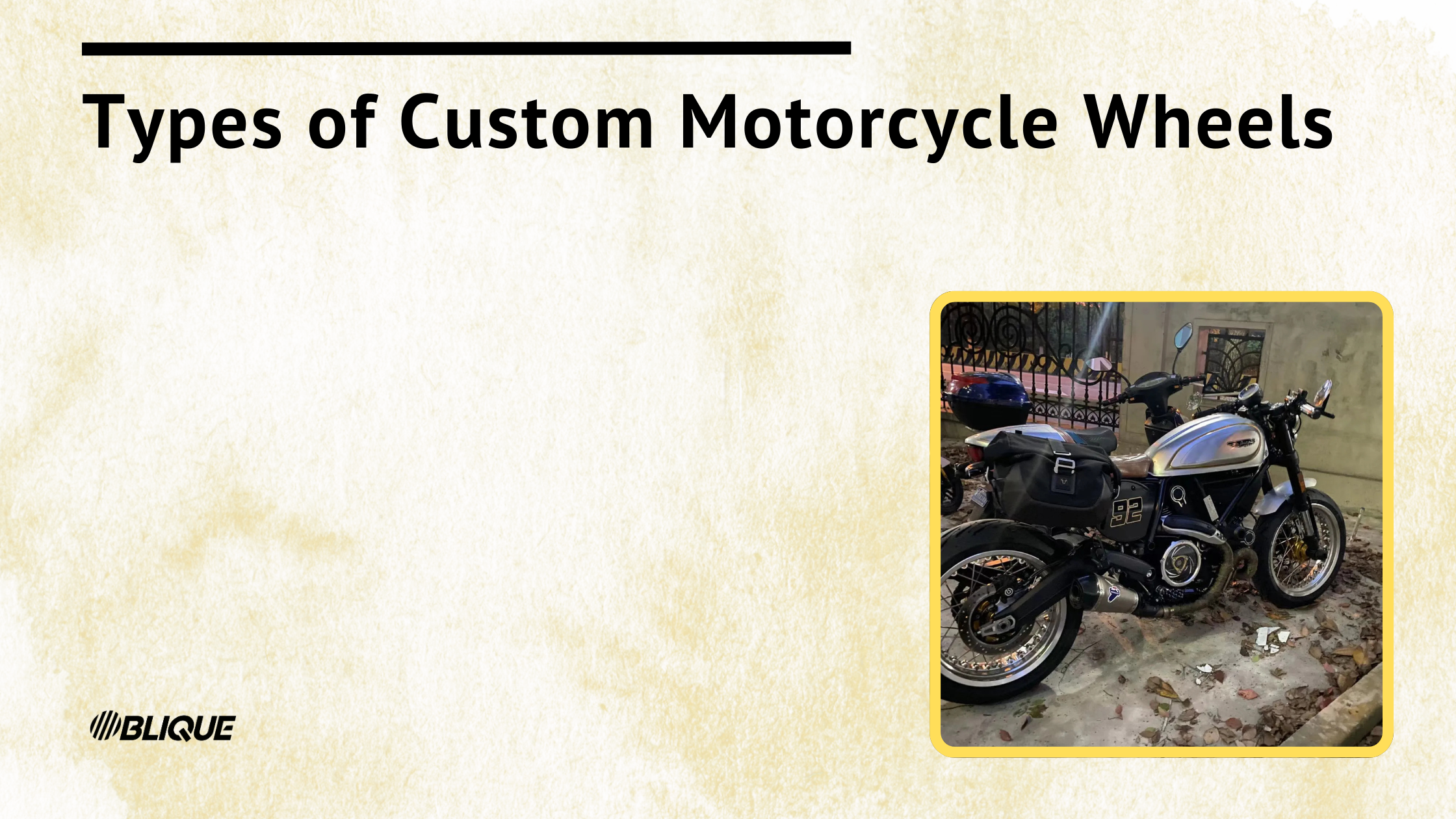
Different construction methods give you different characteristics. Cost, weight, strength, customization options — all vary depending on how the wheel is made.
1. Cast Wheels
Casting is pouring molten metal into a mold and letting it solidify.
Most stock wheels are cast. Most affordable custom wheels are cast too.
Advantages:
- Relatively inexpensive to produce
- Good enough for street riding
- Lots of design flexibility in the mold
Disadvantages:
- Heavier than forged or billet
- Not as strong pound-for-pound
- The grain structure of the metal isn’t as optimized
Cast wheels work fine for most riders. Seriously. If you’re commuting and doing weekend rides, cast aluminum wheels will serve you well. You’re not racing. You don’t need the absolute lightest, strongest option.
Price range usually runs $400-$1,200 per wheel depending on brand, style, and finish. Sometimes less for budget options. Sometimes more for premium cast wheels.
2. Forged Wheels
Forging uses extreme pressure to shape metal rather than melting and pouring it.
This creates a tighter, more uniform grain structure. The result is significantly stronger and lighter than cast.
The forging process itself is expensive. The tooling costs more. The equipment costs more. That all gets passed to you. But you’re getting a measurably better product.
Why forged wheels matter:
- 15-30% lighter than comparable cast wheels
- Considerably stronger
- Better fatigue resistance
- Preferred for high-performance applications
Racing teams run forged wheels almost exclusively. Makes sense — they’re pushing equipment to limits where marginal gains matter.
For street riders, the weight savings translates to better feel and handling. Whether it’s worth 2-3x the cost of cast wheels is personal. I think it is if you can afford it. Some people don’t care that much. Fair enough.
Popular forged wheel brands include Marchesini, BST, Dymag, Galespeed. Expect to spend $1,500-$3,500+ per wheel.
3. Billet Wheels
Billet wheels are machined from a solid block of aluminum. CNC machines carve away everything that isn’t the wheel.
It’s an incredibly precise process. And expensive. You’re paying for a lot of raw material that ends up as metal shavings.
What billet offers:
- Extremely precise dimensions
- Nearly unlimited design possibilities
- Very strong
- Absolutely gorgeous machined finishes
The customization options with billet are insane. Because they’re cut by computer-controlled machines, you can basically design any spoke pattern, any shape. Some of the most intricate, artistic wheels you’ll see are billet.
Weight varies depending on design. They can be made light, but they’re not inherently lighter than forged.
This is premium territory. $2,000-$5,000+ per wheel. Sometimes way more for one-off designs. Billet wheels are for people who want something truly special and have the budget for it.
Companies like RC Components, Performance Machine, and Ridewright specialize in billet stuff.
4. Spoked Wheels vs. Solid Wheels
This is more about style than construction method.
Spoked wheels use individual wire spokes laced between hub and rim. Classic look. Been around forever.
- Traditional aesthetic that suits certain bikes perfectly
- Can be repaired — replace individual spokes if needed
- More labor-intensive to build and true
- Generally heavier than solid wheels
- Some designs can be tubeless now, though many still require tubes
Spoked wheels make sense on cruisers, vintage bikes, scramblers, adventure bikes. They just look right.
Solid wheels (cast, forged, or billet) are one-piece or multi-piece construction without wire spokes.
- Cleaner, more modern look
- Easier to maintain
- Typically lighter
- Tubeless by default
- The performance choice for sport bikes
Neither is objectively better. It depends entirely on the bike and what you’re going for.
Custom Motorcycle Wheel Materials: What Makes the Difference
Material choice affects weight, strength, durability, cost, and even maintenance requirements. Worth understanding before you commit.
Aluminum Alloys
By far the most common material for custom motorcycle wheels.
Different alloys have different properties. The two you’ll see most often:
6061 aluminum: Good all-around alloy. Strong, lightweight, machines well, affordable. Most custom wheels use 6061.
7075 aluminum: Stronger and harder than 6061. Also more expensive and a bit harder to work with. You’ll see this in high-end applications where maximum strength matters.
Both resist corrosion reasonably well, especially with proper finishing.
Aluminum is the sweet spot for most riders. You get significant weight savings over steel without insane cost or exotic maintenance requirements.
Carbon Fiber
The exotic choice.
Carbon fiber wheels are incredibly light. Like, shockingly light when you pick one up. They also have an excellent strength-to-weight ratio. Energy absorption characteristics can reduce vibration too.
Sounds perfect, right? There are tradeoffs.
Considerations:
- Extremely expensive ($4,000-$8,000+ per wheel)
- Can’t be repaired if damaged
- More susceptible to impact damage than metal
- Require more careful handling
- UV exposure can degrade the resin over time without protection
Carbon fiber wheels show up in racing all the time. For street use, they’re a flex more than a necessity. If you’ve got the budget and you baby your bike, they’re amazing. If you’re riding through construction zones and parking in sketchy areas, maybe not ideal.
BST makes some of the most well-known carbon fiber motorcycle wheels.
Magnesium
The lightest option out there.
Magnesium is around 33% lighter than aluminum. In racing, that matters a lot. Some MotoGP wheels are magnesium.
Problems for street use:
- Corrodes easily, especially in wet/salty conditions
- Requires special care and coatings
- Expensive
- Not as widely available
Magnesium wheels exist in the custom market, but they’re rare for street bikes. Most people buying custom wheels for road use go aluminum. The weight penalty versus magnesium just isn’t worth the hassle and expense for regular riding.
How Custom Motorcycle Wheelsets Are Built: The Complete Process
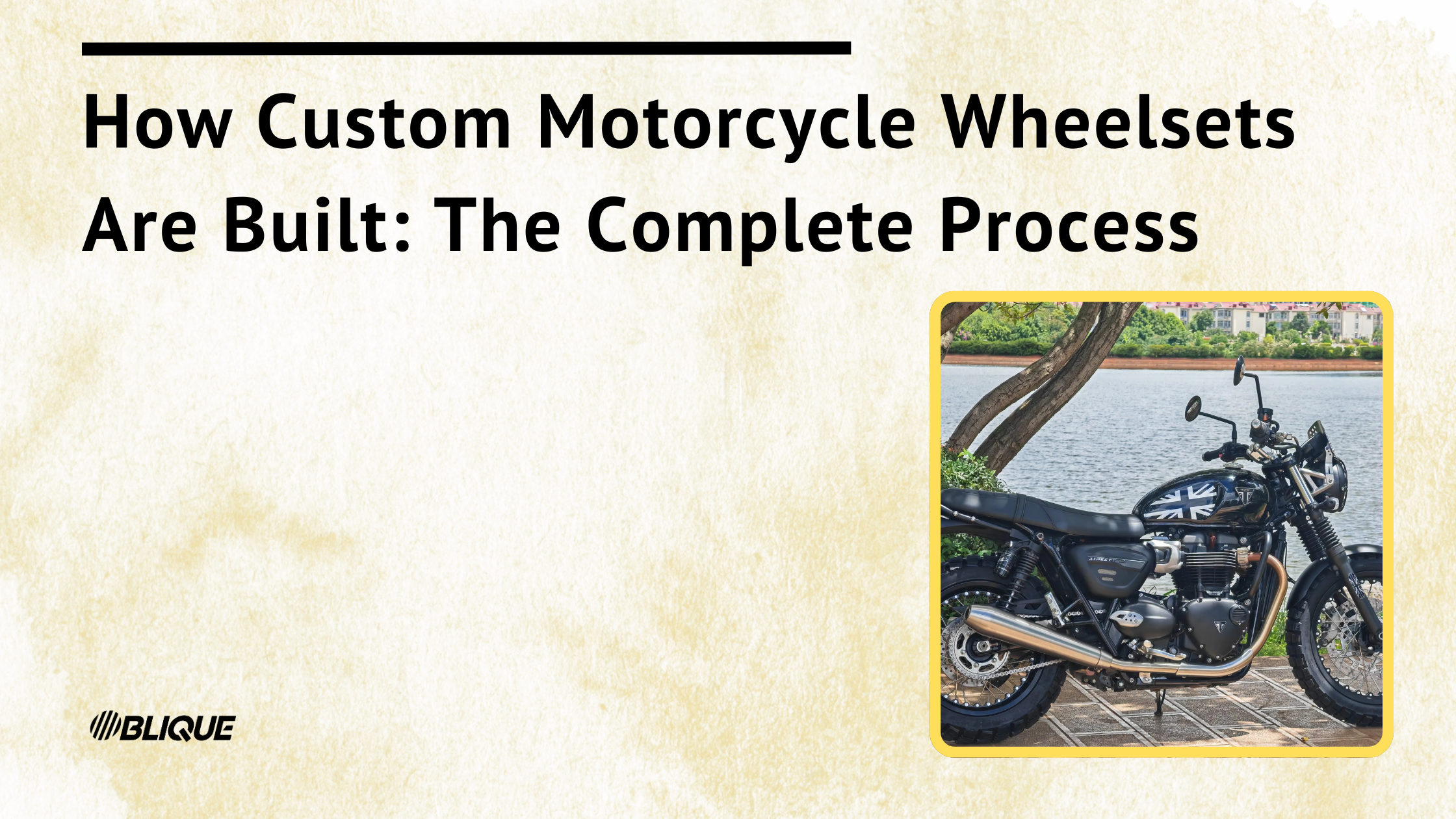
Now for the actual build process.
This isn’t slapping parts together. Building a quality custom wheelset involves engineering, precision manufacturing, skilled craftsmanship, and rigorous quality control. Good shops treat each build seriously because failures mean people get hurt.
Let me walk through how it works.
Step 1: Design and Specifications
Everything starts with figuring out exactly what needs to be built.
The consultation process covers:
- What bike are we building for? Year, make, model matters enormously.
- What’s the riding style? Street, track, touring, off-road?
- Aesthetic preferences — style, finish, colors
- Performance goals — is weight reduction the priority? Strength?
- Budget constraints
Then the technical specs get locked in. Axle diameter. Wheel offset. Brake rotor compatibility — are we working with existing rotors or new ones? Sprocket fitment for the rear wheel. Tire size requirements.
Some shops do CAD work to model the wheel digitally before anything gets built. You might see renderings of what the finished product will look like. This is where you catch problems before they become expensive problems.
Customer approval at this stage is important. Once manufacturing starts, changes get costly.
Step 2: Material Selection
Based on everything discussed in step one, the builder selects appropriate materials.
This isn’t always complicated. For most street custom builds, it’s going to be aluminum — probably 6061. But even then, there are decisions. What grade? What supplier? Is the raw material certified?
If you’re doing carbon fiber or something more exotic, material selection becomes more involved.
The material choice ripples through the entire build. It affects which manufacturing processes work, what finishes are possible, how thick sections need to be for strength, what the final weight will be.
Step 3: Wheel Manufacturing
Here’s where the actual wheel gets made. The process depends on the type of wheel.
For cast wheels: The molten aluminum alloy gets poured into precision molds. Once cooled and solidified, the rough casting gets removed and machined to final dimensions. Quality castings require good mold design and careful temperature control. Poor casting processes create porosity — tiny air pockets that weaken the wheel.
For forged wheels: Aluminum billets get heated and pressed with enormous force in forging dies. This aligns the grain structure of the metal, creating superior strength. After forging, CNC machining brings everything to final dimensions.
For billet wheels: Solid aluminum blocks go into CNC machines that carve away material according to the digital design. This process wastes a lot of material but allows incredibly precise, complex shapes. Multiple machining operations might be needed — roughing, finishing, drilling, etc.
Throughout manufacturing, quality control checks happen. Dimensional measurements. Visual inspection. Sometimes X-ray or other non-destructive testing to find internal defects.
For wheels being sold in certain markets, certification standards apply. DOT certification for the US. TÜV for European markets. These require documented testing and quality processes.
Step 4: Hub Preparation and Customization
The hub is the center of the wheel where everything connects — bearings, brake rotors, sprockets, axle.
For one-piece wheels (most cast, forged, and billet), the hub is integrated into the wheel itself. The machining process creates the bearing seats, rotor mounting points, and axle bore all in one piece.
For spoked wheels, hubs are often separate components. They might be made by the wheel builder or sourced from specialized hub manufacturers. Either way, they need to be precisely machined for the specific application.
Bearings get pressed in. Usually quality sealed bearings rated for the loads involved. Cheap bearings here would be stupid — bearings are not where to save money.
Everything needs to match: brake rotor bolt pattern and diameter, sprocket mounting, axle diameter and any spacer requirements.
Hub finishes can match or contrast with the rim. Polished hubs with powder-coated rims look great on some builds.
Step 5: Spoke Lacing (For Spoked Wheels)
This step only applies to traditional wire-spoked wheels. If you’re getting cast, forged, or billet solid wheels, skip ahead.
Spoke lacing is where the wheel really comes together. It’s a craft. Done right, it’s borderline art.
Spoke patterns:
- Cross-3: Each spoke crosses three others. Standard pattern. Good strength.
- Cross-2: Crosses two spokes. Slightly different load characteristics.
- Radial: Spokes go straight from hub to rim. Looks distinctive. Less common on motorcycles.
The builder chooses spoke material (usually stainless steel), thickness (gauge), and length calculated for the specific hub and rim combination. Getting spoke length wrong ruins everything.
Lacing is done by hand. One spoke at a time, following the pattern. It’s tedious work that requires attention.
Once all spokes are in place, initial tensioning happens. This is just getting everything roughly seated before proper truing begins.
Some custom builders create artistic spoke patterns — different colors, varying thicknesses, unusual crossing patterns. These take even longer and cost more.
Step 6: Wheel Truing and Balancing
Possibly the most important step for how the wheel actually performs.
Truing means making the wheel perfectly round and flat.
- Radial runout: The wheel should be the same distance from the axle at all points. No high or low spots around the circumference.
- Lateral runout: The wheel should be perfectly flat, no wobble side to side.
For spoked wheels, truing involves adjusting individual spoke tensions. Tighten here, loosen there, gradually bringing everything into spec. It’s a skill developed over years.
For solid wheels, truing issues indicate manufacturing problems. The wheel should come off machines true. Minor imperfections get addressed by machining.
Tolerances matter. Racing specs are tighter than street specs. But even street wheels shouldn’t have more than tiny amounts of runout.
Balancing distributes weight evenly around the wheel. An unbalanced wheel vibrates at speed. That’s annoying and adds stress to bearings, suspension, and everything else.
Professional balancing equipment identifies where weight is needed. Small weights get added — usually adhesive weights on the rim interior where they won’t be visible.
Static balancing (wheel stationary) catches most issues. Dynamic balancing (wheel spinning) catches the rest. Good shops do both.
Final inspection happens here. Any issues found mean going back to earlier steps.
Step 7: Finishing and Coating
The wheel works. Now it needs to look right and be protected.
Surface prep comes first. Depending on the finish chosen, this might involve sanding to various grits, polishing, media blasting, chemical cleaning. The surface needs to be perfect before coating because imperfections show through.
Finishing options:
Powder coating: Dry powder gets electrostatically applied then baked to cure. Creates a tough, durable finish. Available in basically any color. Matte, satin, gloss, textured — all possible. Most popular finish for custom wheels by far.
Anodizing: Electrochemical process that creates a hard oxide layer on aluminum. The color becomes part of the surface, not a coating on top. Very durable. Color options are more limited than powder coating but include nice metallic looks.
Chrome plating: Multiple metal layers electroplated onto the surface. Classic high-shine look. Requires more maintenance than powder coating. Environmentally problematic process, so fewer shops offer it.
Ceramic coating: Thin clear coating that adds protection and can be applied over other finishes or bare metal. Not as durable as powder coating but works where other finishes don’t.
Clear coat: For protecting polished or brushed bare metal looks.
Custom graphics, logos, or engravings can be added before final coating. Some shops do vinyl decals under clear coat. Others do actual engraving that gets filled with contrasting color.
After coating, proper curing happens. Rushing this step means the finish won’t hold up. Quality shops let wheels cure fully before shipping.
Step 8: Final Quality Control and Testing
Before a wheel leaves the shop, it goes through final checks.
Comprehensive inspection includes:
- Dimensional verification: All critical measurements confirmed
- Visual inspection: Finish quality, no defects, no damage
- Bearing function: Smooth rotation, no play
- Mounting points: Threads clean, surfaces flat
- Documentation: Everything matches the order
Test fitting might happen if the shop has access to the same model motorcycle. This catches any fitment issues before the customer gets the wheels.
Certification documentation gets prepared. Serial numbers, specifications, test results if applicable.
Warranty information accompanies the wheels. Reputable builders stand behind their work. Typical warranties cover manufacturing defects but not crash damage or improper installation.
Step 9: Installation and Setup
You have your wheels. Now they need to go on the bike.
Honestly? I’d recommend professional installation unless you really know what you’re doing. Wheel installation affects every safety-critical system on the motorcycle — brakes, suspension, drivetrain.
What installation involves:
Tire mounting: New tires or transferring existing tires. This requires proper equipment. Make sure the tire matches the wheel size and that the combo is appropriate for your bike.
Brake rotor installation: If using new rotors or relocating existing ones. Torque specs matter here. So does orientation.
Sprocket installation: Rear wheel. Again, proper torque. Verify alignment with the front sprocket.
Final balancing: With the tire mounted. The bare wheel was balanced, but the tire affects balance too.
Installation on motorcycle: Proper axle torque, proper spacer placement, proper brake caliper alignment. Everything needs to be right.
Torque specifications: Axle nuts, rotor bolts, sprocket nuts all have specified torque values. Use a torque wrench. Guessing is not acceptable.
Test ride: Short ride to confirm everything works. Brakes feel right? No vibration? No weird handling? Then longer ride to verify at highway speeds.
Speedometer calibration might be needed if wheel diameter changed significantly. Most modern bikes can be recalibrated through the ECU. Some need speedo healers or replacement sensors.
How long does it take to build custom motorcycle wheels?
Depends on what you’re ordering and who’s building them.
Semi-custom wheels from a catalog — picking existing styles in your sizes and finishes — might ship in 2-4 weeks if the shop has components in stock.
Fully custom builds take longer. The design phase alone can be a week or two of back-and-forth. Manufacturing, depending on complexity, adds several weeks. Finishing adds more time.
Realistic timeline for a full custom build: 6-12 weeks. Sometimes longer for extremely complex or exotic builds.
Don’t rush your builder. Quality takes time. A shop that promises custom wheels in two weeks is either lying about the “custom” part or cutting corners somewhere.
Shipping adds time too, especially for international orders.
Are custom wheels safe and street legal?
From reputable manufacturers, yes.
Quality custom wheels meet or exceed safety standards. Companies selling wheels in the US typically have DOT certification. European markets require TÜV or similar certification. These certifications require testing — load tests, impact tests, fatigue tests.
The key word is “reputable.” Random eBay wheels from unknown manufacturers? I wouldn’t trust them.
Professional installation matters too. The best wheel in the world is dangerous if installed wrong. Axles torqued improperly, brakes aligned incorrectly, bearings seated badly — any of these can cause failures.
Insurance and registration shouldn’t be issues with properly certified wheels. But if you’re modifying wheel sizes significantly, check local regulations. Some jurisdictions care about this more than others.
Can I install custom wheels myself?
You can if you have the skills and tools. But be honest with yourself about whether you actually do.
What you need:
- Proper stands and lifting equipment
- Torque wrench with appropriate range
- Bearing installation tools if needed
- Understanding of brake systems
- Understanding of drivetrain alignment
- Access to service manual for torque specs
What can go wrong:
- Axle not properly torqued: Wheel can come loose
- Brake caliper misaligned: Rotor damage, poor braking
- Bearings installed wrong: Premature failure
- Sprocket misaligned: Chain wear, potential failure
- Spacers wrong: Wheel doesn’t sit correctly
If any of this goes wrong at speed, you crash.
I’m not trying to scare you off working on your own bike. I believe in learning mechanical skills. But wheels touch every critical system. If you’re not confident, pay a professional. It’s not that expensive and it’s way cheaper than hospital bills.
Also consider warranty. Some wheel manufacturers require professional installation for warranty coverage.
Do custom wheels affect motorcycle performance?
Yes. That’s kind of the point.
Acceleration: Lighter wheels spin up faster. You feel this especially from stops and during hard acceleration.
Braking: Lighter wheels slow down faster. Rotating mass resists changes in speed. Reduce the mass, reduce the resistance.
Handling: Lighter, stiffer wheels make the bike more responsive. Direction changes happen quicker. The suspension works more effectively with reduced unsprung weight.
Suspension: With less unsprung weight to control, your suspension can react faster to bumps and maintain better tire contact.
Speedometer: If wheel diameter changes significantly, your speedometer will read incorrectly. Larger wheels read slow, smaller wheels read fast. Recalibration might be needed.
Odometer: Same issue. If your wheel size changed, your accumulated mileage is slightly off.
The performance differences aren’t always huge in everyday riding. But they’re real. And they add up with rider skill. Better riders notice improvements more because they’re closer to the limits of the equipment.
Can custom wheels fit any motorcycle?
Not any wheel on any motorcycle, no.
Custom wheels are built for specific applications. The wheel needs to fit:
- Your axle diameter
- Your brake rotor mounting pattern
- Your sprocket/pulley mounting (rear wheel)
- Your swing arm width and clearance
- Your front end design
- Your intended tire size
Good custom wheel builders make wheels for specific motorcycle models. They’ve done the engineering to ensure fitment. They know what offsets work, what clearances are needed.
Some wheel designs cover multiple bikes with adapters or different hub configurations.
Can you make a wheel fit a bike it wasn’t designed for? Sometimes. With fabrication. With custom spacers. With modified brake setups. This is where things get expensive and potentially sketchy if not done correctly.
Stick with wheels designed for your bike. Or be prepared for custom fabrication work.